Watchful Waiting is Still Care
How pediatricians decide when to worry, and why you’re not “doing nothing” when you choose to watch
The house is finally quiet.
Your kids are in bed (hopefully for the whole night!). The dishes are done. The toys are sort of picked up. You sit down on the couch with your phone in hand, and suddenly your mind starts racing. And before you know it, you’ve moved into worse-case-scenario zone.
That cough sounded worse tonight. Could it be pneumonia?
The fever came back sooner than you expected. What if this is actually something really bad, like leukemia?
They didn’t eat much at dinner. Could they be getting sick again?
They seemed less smiley today. Could this be the start of a developmental problem?
You start to wonder: Should I be worried? What am I missing? Is something terribly wrong?
Does this sound familiar? You’re not alone. And you’re not overreacting. This winter has been loud—email after email from school about outbreaks, illness headlines, and scary social media stories that make it hard to know what’s normal and what’s not.
Most parents aren’t looking for reassurance that everything is fine (although that doesn’t hurt!). They’re looking for clarity about when things are NOT fine.
Symptoms alone don’t tell the whole story
One of the hardest parts of parenting through illness is that symptoms can look dramatic without being dangerous.
A high fever. A harsh cough. Vomiting in the middle of the night.
These are all signals, not diagnoses.
Two children can have the exact same symptom, but need very different levels of care. That’s why in pediatrics we don’t start by asking, “What is this?” We start by asking, “Is this child safe?”
💡Fun fact: Fever itself is rarely dangerous—it’s a sign that the immune system is doing it’s job!
What pediatricians are really assessing
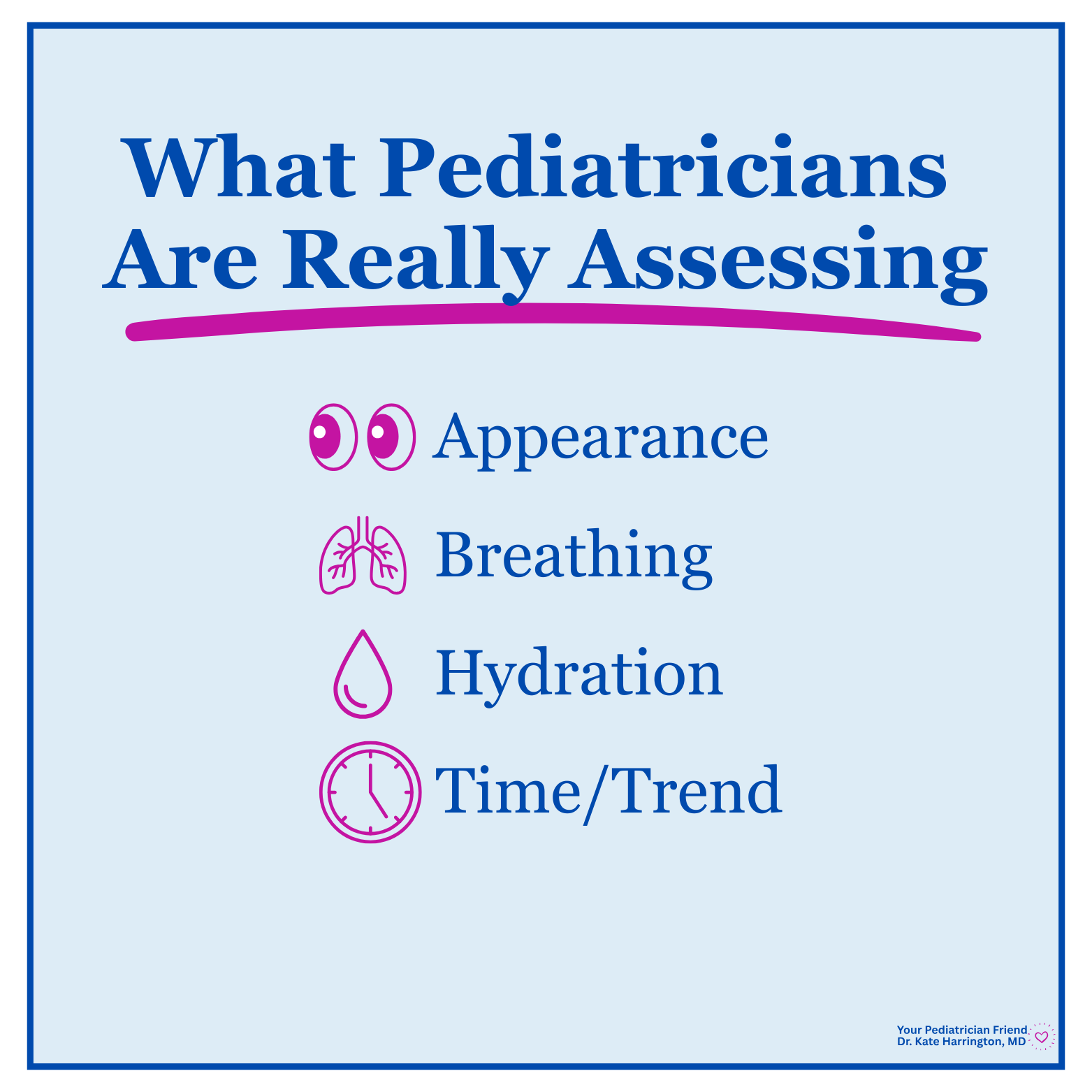
When parents reach out worried about symptoms, there are a few questions we’re always asking—whether we say them out loud or not!
1. How does your child look between symptoms?
Are they alert at times? Are they making eye contact? Do they act like themselves in brief windows?
Children who still have moments of normal behavior, even with uncomfortable symptoms mixed in, are often safer than they appear.
2. How is their breathing?
We are less worried about how a cough sounds (although it is helpful!). The most important thing is how comfortable they are breathing.
Are they breathing easily at rest? Or working hard to breathe, breathing very fast, or using extra muscles to get air in? This matters more than how loud or frequent a cough is.
3. Are they staying hydrated?
Appetite can wait. Hydration can’t.
Small sips count. Popsicles count. Urine output matters more than how much they’re eating. Vomiting or diarrhea is assessed through hydration, not how many times they’ve thrown up in the last few hours.
4. What is the trend over time?
One rough hour is different from a pattern of worsening symptoms.
Time is information. Improvement, stability, or gradual worsening tells us more than a single moment ever could.
🩺 Pediatrician’s Insight: Many parents are already watching the same things pediatricians use to assess safety--behavior, breathing, hydration, and trends over time. However, they just don’t realize they’re doing exactly what pediatricians do! You rock!
Situations that are often safe to watch at home
While every child is different, many common situations can be safely monitored with supportive cares and watchful waiting:
Fever in a child who is playful at times
Vomiting that improves between episodes
Coughs that sound awful, but don't cause breathing problems
Kids who perk up after fluids, rest, or fever medication
Watching doesn’t mean ignoring. It means knowing what you’re watching for.
When to seek care more urgently
There are situations where medical care is important, and having clarity here helps parents act with confidence instead of fear.
Seek prompt care if your child:
Is struggling to breathe or breathing looks labored
Breathing fast (over 60 breaths/minute in an infant under age 1, over 40 breaths/minute in an older child)
Using neck muscles to breathe
Nostrils are flaring
Skin between ribs is sucking in with each breath (retractions)
Grunting after each breath
Unable to drink a bottle or nurse because of breathing work
Unable to complete a sentence because out of breath
Looks blue around the lips
🩺 Pediatrician's Insight: Younger babies can have periods of this type of breathing if they are very congested. So, if you notice worrisome breathing (as long as your child is alert and not blue), you can try to suction their nose or take them into the bathroom and turn on a steamy shower to mobilize the congestion. If their breathing returns to baseline, that is reassuring.
Is very lethargic or hard to wake
Can’t keep fluids down and shows signs of dehydration:
No pee/wet diaper at least once every 8 hours
No tears
Dry, tacky mouth
Capillary refill greater than 2 seconds (this is where you gently squeeze the tip of a finger and see how quickly the color returns)
Has severe or worsening pain
Ibuprofen or Tylenol doesn’t help
Pain is waking them up
Unable to stand up straight or jump because of pain
Is less than 3 months old and has a fever of 100.4°F or above
Just doesn’t look right to you, in a way that feels different than usual (your intuition is important!)
These guidelines aren’t meant to make you anxious. They’re meant to help you trust your instincts and know when to act.
Watchful waiting isn’t neglect—it’s an active skill
There’s a common misconception that waiting means doing nothing.
In reality, watchful waiting means:
Monitoring hydration
Watching breathing
Noticing behavior changes
Tracking trends over time
It’s actually an active decision. And it’s often the safest one. And it is often the right move—most kids will get better with time.
Why these moments feel harder at night
Some symptoms certainly do worsen at night. However, our ability to tolerate uncertainty definitely worsens at night!
We’re tired. More isolated. Less able to reach out for reassurance. And some theories even suggest that evolution wired parents to be extra alert when things go quiet (you never know when that silent predator may be lurking!).
If nighttime worry feels heavier, that’s not weakness. It’s biology! And it’s normal.
💡Fun Fact: Nighttime anxiety peaks when fatigue is highest and access to reassurance is lowest—not because symptoms are suddenly more dangerous.
You don’t have to navigate the gray zone alone 🩷
Most parenting stress feels heaviest in the in-between moments—when something doesn’t feel bad enough for urgent care, but doesn’t feel good enough to ignore.
That gray zone is exactly where pediatric guidance helps most.
If you ever find yourself lying awake wondering whether to wait or worry, please know this: you’re not anxious, you’re responsible. And you deserve support in making those decisions.
If you need help navigating those gray-area moments, I’m always here to help 💕