Over 60% of What Kids Eat Is Ultra-Processed. Here's How to Change That Without Losing Your Mind!
I recently sat through a really excellent webinar from the American Academy of Pediatrics on ultra-processed foods and children's health. And I came away with one overwhelming thought: parents need to hear this! But I don’t want to present it in a scary, guilt-inducing “it’s your fault” kind of way. Because no one deserves that! Instead, I want to give you the facts and offer some realistic ways we can all work together to try and change the situation.
So, here's what I learned (filtered through nearly 20 years of talking with real families about real food)!
Let's start with the number that felt like a sucker punch to the gut: American kids ages 1–18 get about 62% of their daily calories from ultra-processed foods. Woah. That's nearly two-thirds of everything they eat. But before you spiral, know that this is not a reflection of bad parenting! It's a reflection of the food environment we're all navigating together. More on that in a minute.
First, let's talk about what "ultra-processed" actually means, because it may not be what you think.
What Is an Ultra-Processed Food, Exactly?
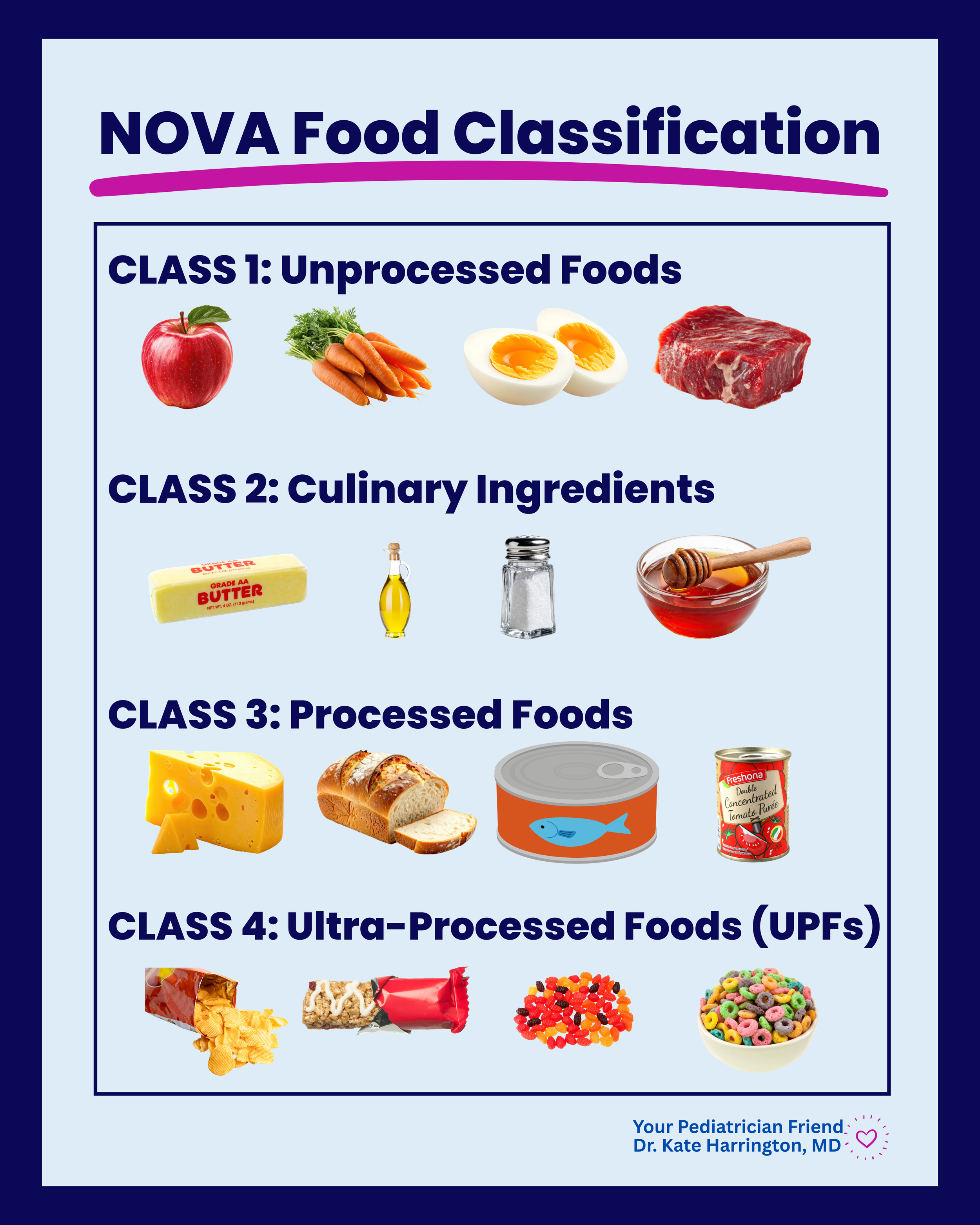
The term comes from a food classification system called NOVA, developed by researchers to categorize foods based on how much industrial processing they've undergone. There are four groups:
Group 1: Unprocessed or Minimally Processed Foods. These are fruits, vegetables, eggs, plain meat, milk, nuts, seeds, and grains. They look like they could have come from a farm, and may be dried, frozen, chilled, pasteurized, or may have undergone a process to remove inedible or undesirable parts. Importantly, no additions have been made to the food.
Group 2: Culinary Ingredients. This group includes butter, oil, sugar, salt, and honey. These are generally pressed or refined from foods found in nature, and are used to season and cook foods.
Group 3: Processed Foods. Things like cheese, canned fish, fermented vegetables, and simple breads are processed foods. These have been altered from their natural state, but in relatively straightforward ways and with recognizable ingredients.
Group 4: Ultra-processed foods (UPFs). UPFs are industrial formulations containing five or more ingredients, manufactured by deconstructing foods into their components, modifying them, and recombining them with additives you would never find in your home kitchen—things like hydrolyzed proteins, maltodextrin, high fructose corn syrup, artificial flavor enhancers, stabilizers, and bulking agents. These ingredients exist not to nourish, but to enhance taste, extend shelf life, and make the product as appealing (and as easy to overeat!) as possible. Think of them as foods created in a lab.
The key thing to know about the NOVA system is that the problem isn't processing itself—it's the degree and type of processing. Frozen vegetables are processed. Plain yogurt is processed. Canned beans are processed. But none of these are a concern! The concern is Group 4— products engineered in a way that goes way beyond anything you can do in your own kitchen.
When you're trying to figure out if something qualifies, ask yourself: “could I make this at home with ingredients I recognize?” If the answer is "definitely not, and I don't even know what half of these ingredients are!" you're probably looking at a UPF.
🩺 Pediatrician's Insight: It is easy to see a product plastered with “Made with Whole Grains” on the front, and automatically classify it as healthy. However, these claims are what the food industry calls a "health halo"—a claim designed to make a product seem healthier than it really is. A cereal can truthfully say "made with whole grains" while still containing 12 grams of added sugar per serving and a lengthy ingredient list full of additives. Always flip the box and check the actual ingredient list and Nutrition Facts panel. Remember, the front of the package is just marketing!
How Much Are Kids Really Eating? And Does It Matter?
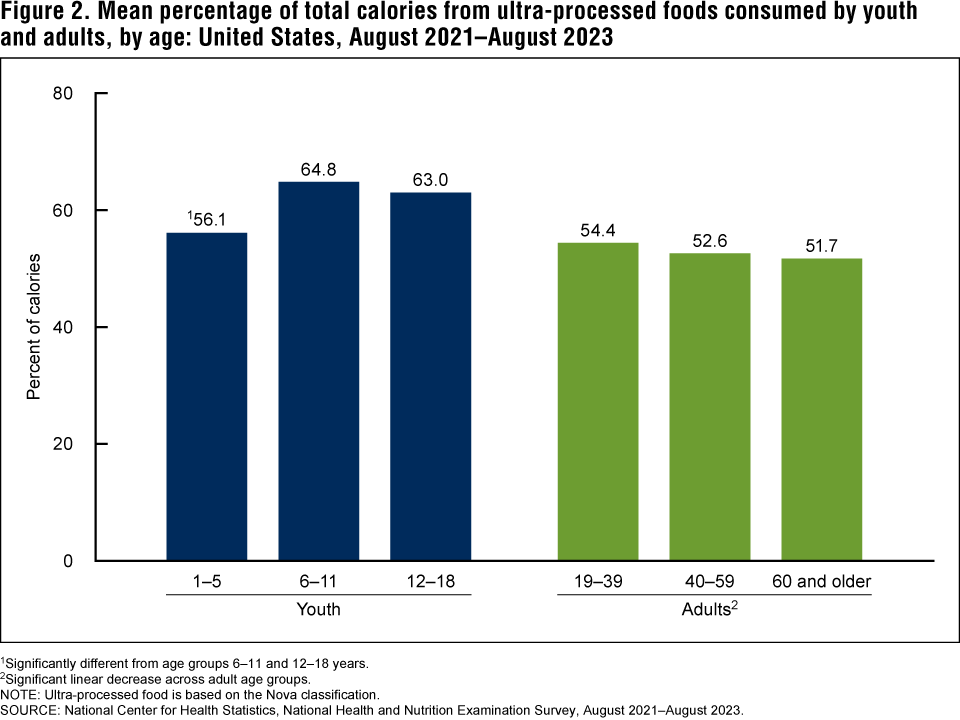
Let’s get back to that 62% number I referenced above. According to CDC data from 2021–2023, children and adolescents get 61.9% of their daily calories from ultra-processed foods. This is significantly more than adults, who are closer to 53%. And notably, UPF intake actually increases with age during childhood: kids ages 6–11 get 64.8% of calories from UPFs, and teens ages 12–18 get 63.0%, compared to 56.1% for the youngest children ages 1–5.
The foods driving the most UPF consumption in kids aren't the obvious junk food. Instead, they are the everyday items: breakfast foods, snacks, and lunchbox staples. Sandwiches (including burgers), sweet bakery products, savory snacks, pizza, and sweetened beverages are the top calorie contributors from UPFs for both kids and adults.
💡 Fun Fact:For adults, ultra-processed food consumption is lowest among higher-income households—wealthier adults tend to eat fewer UPFs. But for children, income level makes no difference at all. Kids across all income brackets eat roughly the same high percentage of ultra-processed foods.
On the medical side, the evidence associating UPFs with poor health is growing. However, as with most medical research, the strongest research has been done in adults. So, we need more pediatric-specific data. With that said, here's what we know:
A landmark 2019 randomized controlled trial by Hall and colleagues in Cell Metabolism found that even when researchers matched ultra-processed and unprocessed diets for calories, sugar, fat, fiber, and macronutrients, participants on the ultra-processed diet spontaneously ate significantly more calories and gained weight. People on the unprocessed diet ate less and lost weight. So, the same nutrients on paper, but very different outcomes!
A 2025 review by Juul and colleagues in Nature Reviews Endocrinology found that UPFs appear to influence weight through multiple pathways: they activate food reward systems in the brain, they disrupt appetite and satiety signaling, and they negatively alter the gut microbiome. The authors noted that we especially need more research on these effects during childhood, adolescence, and pregnancy (yes! These are the life stages where the stakes are the highest!)
It’s important to remember that it isn’t any single food that is dangerous. It's that when 62% of a child's calories come from one category of food, there's not much room left for the variety that growing bodies actually need.
Why This Is Hard (And Why It's Not Your Fault!)
Are you ready for this? Because this is the most important section for parents to read.
Families aren't reaching for ultra-processed foods because they don't care or because they are bad parents. They're doing it because they're navigating a food environment that has been systematically shaped to make UPFs the path of least resistance. Consider everything that’s working against you:
Time. Busy schedules, dual-income households, limited time for meal prep…we all can relate! When you're rushing out the door at 7am, or getting home at 6:30pm after soccer practice, "quick and easy" wins. Every. Single. Time.
Availability. As you know, convenience foods are everywhere! Fresh, whole foods are not equally accessible in all communities, and even when they are, they take more time and skill to prepare.
Marketing. Children under 12 are exposed to more than 1,000 food advertisements per year on television alone—and the majority of those ads are for unhealthy products. Add in digital platforms, social media, and influencer content, and the exposure is even higher. The industry knows exactly how to reach kids for maximum appeal (think packaging, characters, colors, and flavors engineered for maximum appeal). There are also countless products wearing "health halos"—words like "natural," "made with whole grains," or "no artificial colors" on packages that trick you into thinking it’s a good choice. But, when you look at the ingredient list, they are still deeply ultra-processed.
💡 Fun Fact: In 2006, a group of food, beverage and restaurant companies pledged to only advertise healthy products on children’s television programming, and this was further revised in 2014 and 2020 when nutritional criteria for what qualifies as “unhealthy” was established. However, most of the ads children see for food are during general programming, not kid’s shows.
School and childcare. Packaged snacks are the norm in most school and childcare settings. As parents, you can't control what gets served or what other kids bring and share.
Peer influence. We’ve all seen it—kids want what their friends eat! “But mom, all my friends eat Flamin’ Hots!” Social norms around snack foods are powerful, especially as kids get older.
None of this is a personal failing. Please believe me! In 20 years of pediatrics, I have never once met a parent who did not care about their child's health. The barriers to healthy eating are real, and they are structural. And the goal isn't to totally eliminate all UPFs from your child’s diet. It's to find a handful of changes that decrease their UPF intake, that are actually sustainable for your family.
So Where Do You Actually Start? Added Sugar Is a Good Place.
Okay. So now we know that kids consume A LOT of UPFs, that it is not good for their health, and that there are a lot of contributing factors that we can’t control. So what CAN we actually do? Well, a good place to start is added sugar. It's not the only thing that matters, but it's one of the clearest, most measurable markers of ultra-processed food intake. And, it's something you can actually track on a food label right now!
The American Academy of Pediatrics and American Heart Association give us a concrete target: zero added sugars for children under 2, and less than 25 grams (6 teaspoons) per day for ages 2 and up.
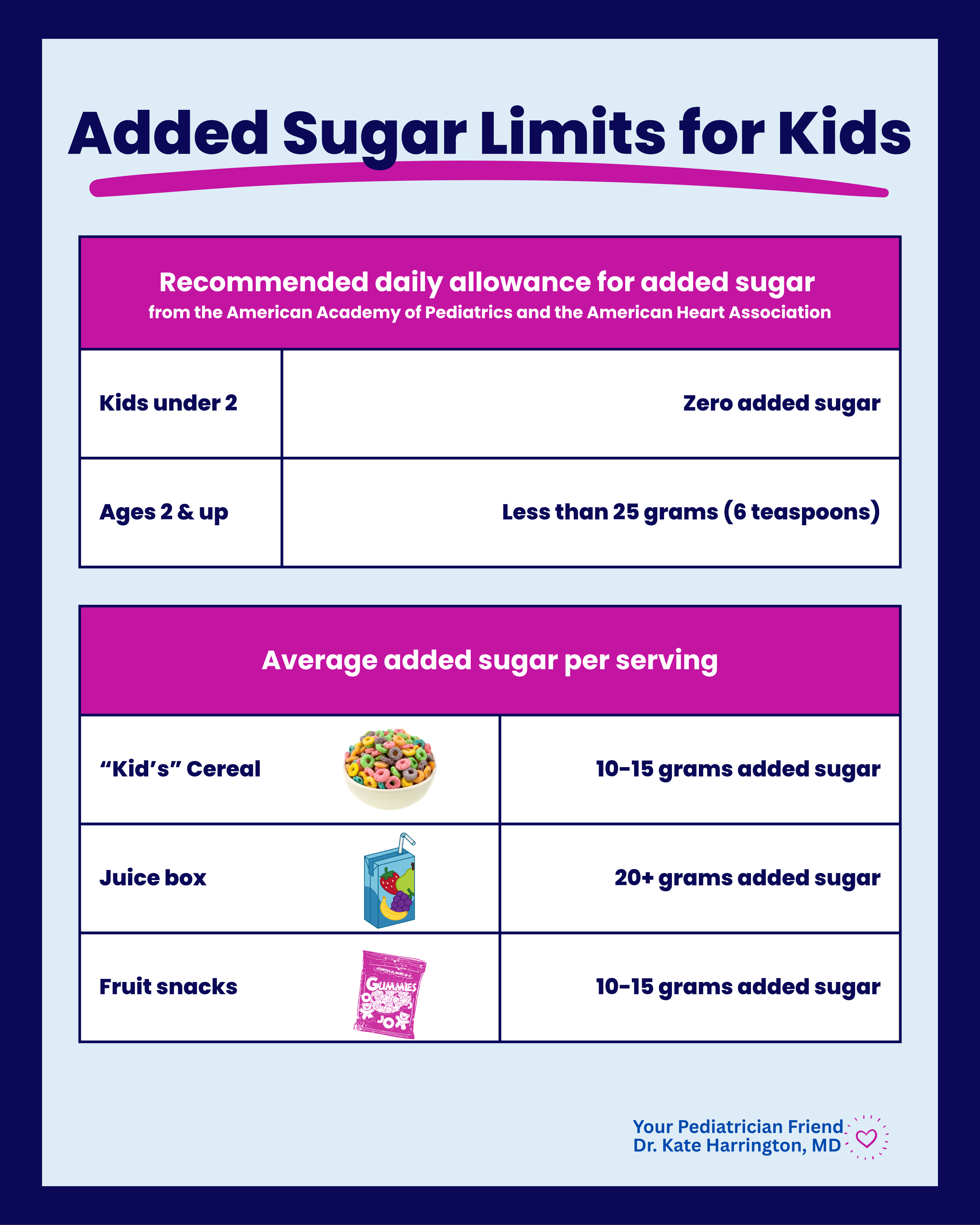
Twenty-five grams of added sugar sounds reasonable…until you realize how fast it adds up. A single bowl of many popular kids' cereals contains 10–15 grams. A juice box can have 20+ grams. A typical fruit snack pouch runs 10–15 grams. A child can hit their entire daily limit before lunchtime without eating anything that feels like a treat. Ugh.
This is why added sugar is such a useful lens for reducing ultra-processed foods specifically: UPFs are the primary source of added sugar in kids' diets. When you chip away at added sugar, you're almost automatically chipping away at ultra-processed food intake at the same time. The strategies in the next section are built around exactly that.
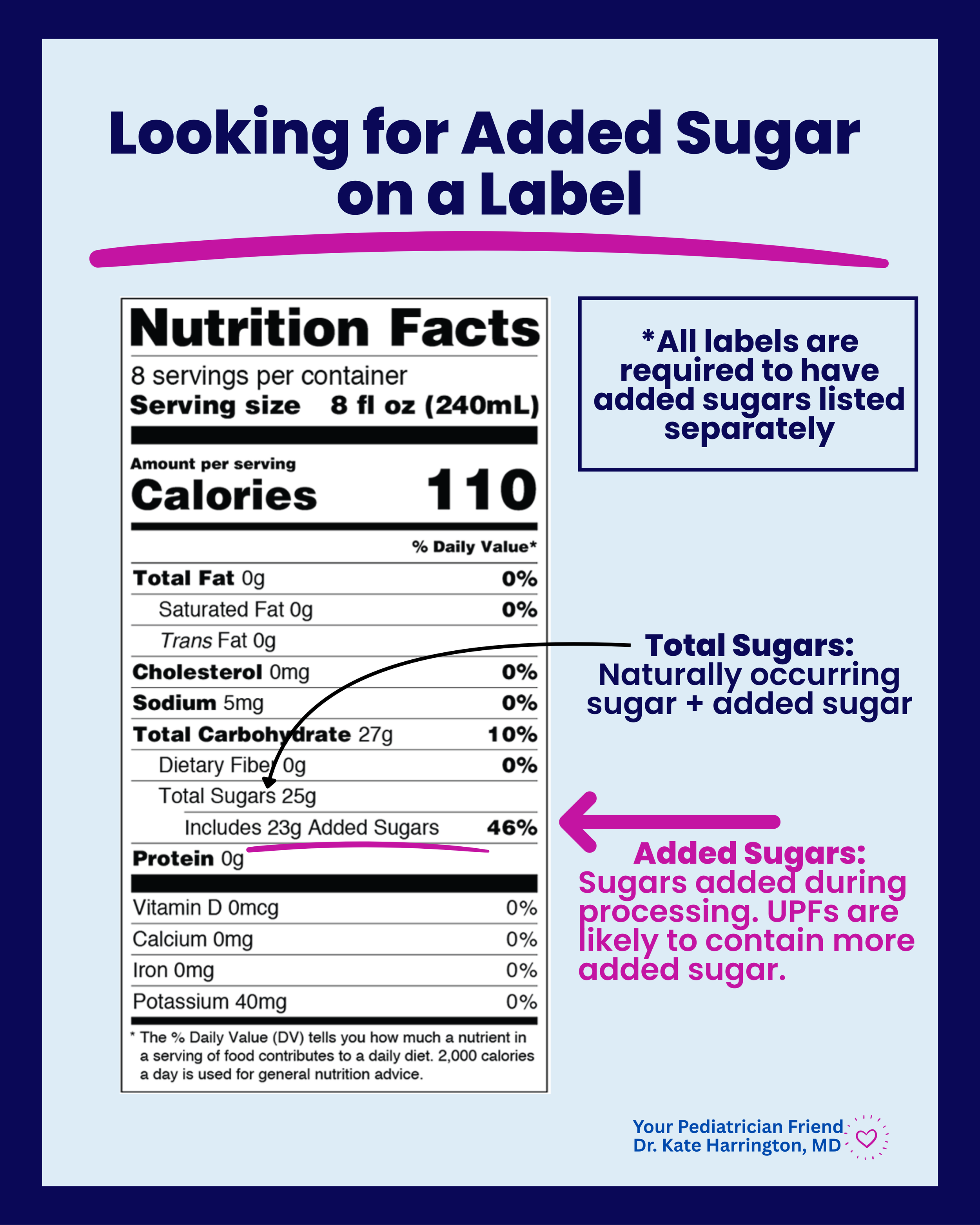
🩺 Pediatrician’s Insight: "Added Sugars" became its own required line on the Nutrition Facts label in 2020, and that is the line to watch. If a single serving of something has more than 6–8g of added sugar, that's a meaningful chunk of a child's daily limit. But remember, context matters: one food with 8g isn't a crisis, but eight foods with 8g is a problem. (And naturally occurring sugars in fruit and dairy are different, and don’t need to be counted.)
Three Scenarios and Six Strategies to Apply to Real Life
The webinar I attended did something I loved: instead of listing generic tips, it walked through real family scenarios. It was so practical and relatable! So, I'm going to do the same.
Scenario 1: "I Don't Want a Battle at Breakfast"
Sound familiar? Mornings are chaotic!! Your child eats the same cereal every day because it's fast, they'll actually eat it, and you are already battling your child to at least wear a sweatshirt with those shorts. You do not have bandwidth to add a fight about food at 7am. Been there, done that. Completely understandable.
The problem is that many cereals marketed directly to children contain 10–15 grams of added sugar per serving. Added sugars are one of the main contributors to excess calorie intake and poor diet quality in children, and breakfast is often where a significant chunk of that daily intake appears.
💡 Fun Fact: A 2025 study in JAMA Network open by Zhao and colleagues analyzed 1,200 children's cereals launched in the US between 2010 and 2023 and found that the average single serving of children's cereal contains more than 45% of a child's entire daily recommended added sugar limit—and that sugar content in newly launched cereals has been trending upward, not down, over the past decade.(And interestingly fat and sodium also increased, while protein and fiber decreased—not good news all around).
Strategy 1: Upgrade the Cereal (Without a Full Battle)
Okay, the good news is that you don't have to totally overhaul breakfast. You just need a better cereal!
Look for:
≤ 6 grams of added sugar per serving (check the "Added Sugars" line, not total sugars)
Whole grain as the first ingredient (the ingredient list goes in order by weight—first ingredient is what you're mostly eating)
A protein or fruit pairing—adding milk, Greek yogurt, eggs, or fruit alongside the cereal improves satiety (that fullness feeling) and blunts the blood sugar spike
🩺 Pediatrician’ s Insight: Introduce a new cereal on a weekend, not a Monday morning when you're already running late. And, gradual transitions work far better than abrupt ones—if your child pushes back, mix the old cereal with the new one and slowly shift the ratio over time. This often works surprisingly well!
Strategy 2: Learn to Decode a Food Label
Start with the ingredient list. Ingredients are listed by weight, so whatever comes first is most abundant. If sugar or refined flour appears in the first two or three ingredients, it's a significant contributor to added sugar or refined carbohydrates. A good goal with cereal is that a whole grain is the first ingredient.
Then ask yourself: do I recognize most of these ingredients? A shorter, more recognizable ingredient list often signals less processing.
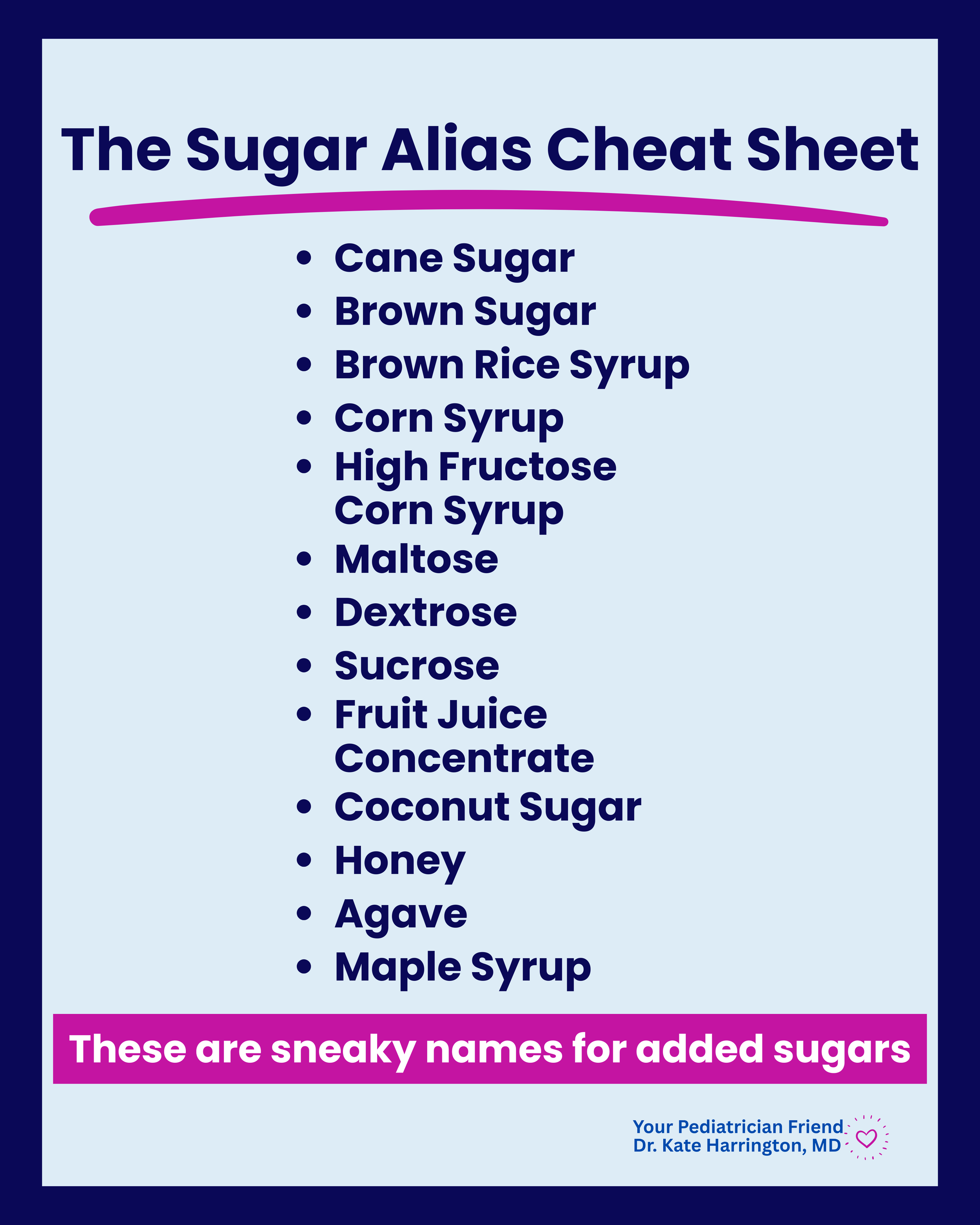
Finally, know sugar's many aliases. Food manufacturers use a lot of different names for added sugar, and they don't have to list them together. Common ones to know: cane sugar, brown sugar, brown rice syrup, corn syrup, high fructose corn syrup, agave, maple syrup, maltose, dextrose, sucrose, fruit juice concentrate, coconut sugar, and honey. Yes, honey, agave, and maple syrup are still added sugars, despite their healthy-sounding reputation.
Scenario 2: "I Pack What I Know She'll Eat"
This is a completely reasonable position because your job as a parent is to feed your kids! And when your kids don’t eat what you are feeding them, it is very distressing (and can make you feel like a failure). But here's a reality check, drawn from the data: a typical lunchbox with a processed meat sandwich, chips, fruit snacks, and a granola bar can deliver 15–25 grams of added sugar and more than 1,000mg of sodium in one meal. That's potentially the child's entire daily added sugar limit, and about 40–50% of their daily sodium limit…for just one meal!
💡 Fun Fact:A 2024 systematic review of research on packed lunches found that sweets appear in nearly half of home-packed lunches, sugar-sweetened beverages in nearly a third, and vegetables in only 17%. Unlike school-provided meals, which must meet federal USDA nutrition standards, there are no nutritional requirements for lunches packed from home. And despite our best intentions, data indicates that they are generally less nutritious.
Strategy 3: The 3-Part Lunchbox Framework
Just like you didn’t need to reinvent breakfast, you don't need to reinvent lunch either! Instead, a simple framework that makes it easier to build a more balanced one help:
Base: sandwich, wrap, or leftovers
Produce: any fruit or vegetable (whatever your child will actually eat—this isn't the place to introduce new things!)
Snack: one to two minimally processed options
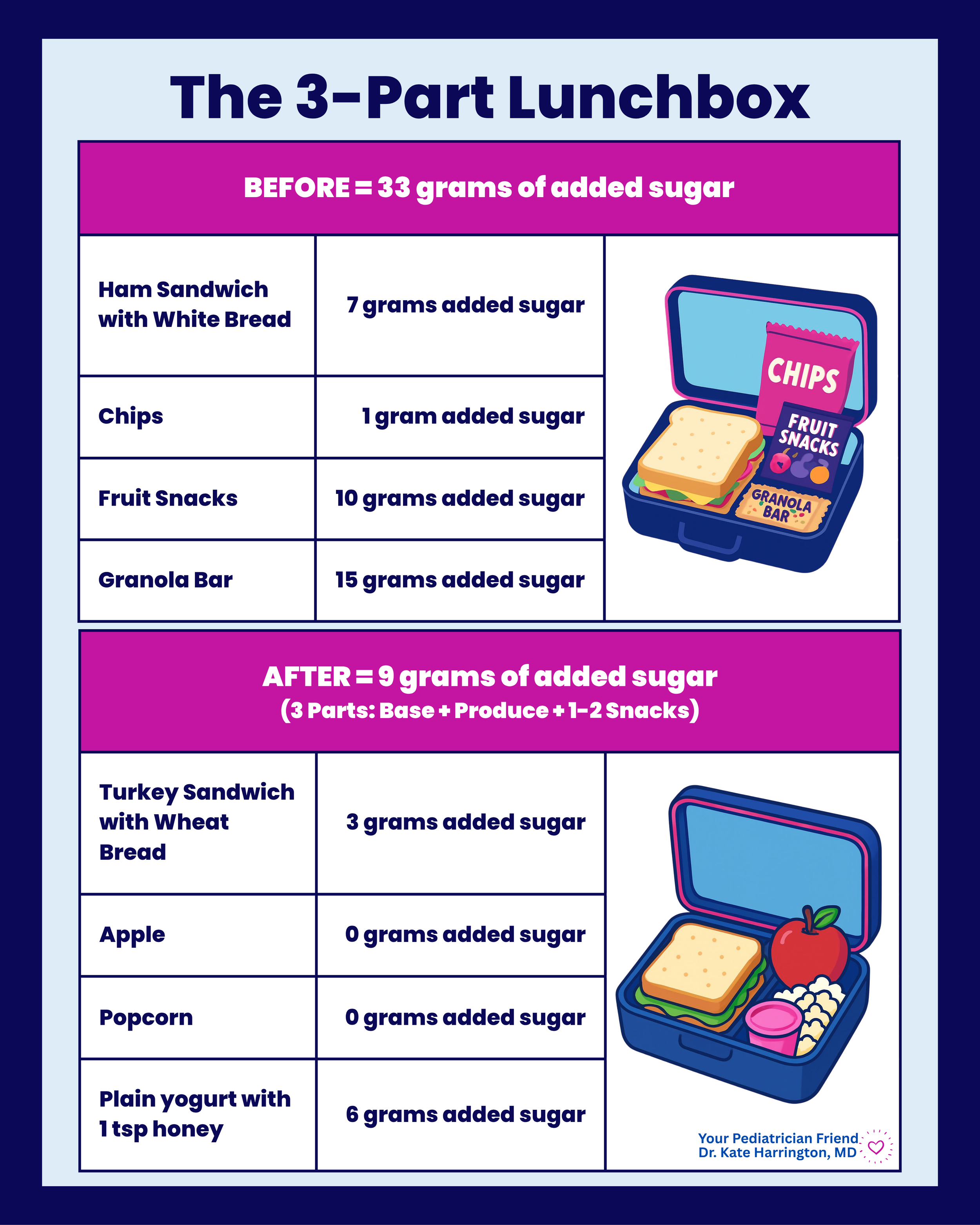
Before: sandwich + chips + fruit snacks + granola bar
After: sandwich + apple + yogurt + popcorn
You don’t have to eliminate the sandwich (or the base), but just try and change the other things. The after version is meaningfully better, and just involves a few simple changes that don't require your child to eat anything too unfamiliar. Reducing even one or two ultra-processed items from the lunchbox can significantly improve overall diet quality. The goal is better, not perfect!
Strategy 4: Simple Meals, Not Perfect Meals
Busy family schedules are genuinely associated with increased reliance on fast food, takeout, and packaged convenience products. (And remember: that is just a structural reality of modern life—not a parenting failure!)
The goal for meals like dinner isn't elaborate home cooking. It's simple, repeatable templates using mostly whole ingredients:
Eggs + whole grain toast + fruit
Rice + beans + vegetables
Pasta + vegetables + whatever protein you have
These meals can be prepared relatively quickly (maybe 15–20 minutes), they don't require a recipe, and they're not overly impressive (and your kids won’t care!). Instead, they're just food assembled from recognizable ingredients. And that is enough!
🩺 Pediatrician's Insight:Cooking at home doesn't have to include elaborate meals with hours of prep. Scrambled eggs take four minutes. Pasta takes fifteen. The benefit isn't the specific food—it's what isn't in it. When you make something from basic ingredients, you control the sodium, the added sugar, and the additives. A bowl of pasta with jarred marinara and frozen vegetables isn't Instagram-worthy, but it contains a fraction of the sodium and additives of a packaged "pasta meal." Perfect is the enemy of good here!
Scenario 3: "We're Always on the Go"
Children typically snack 2–3 times per day. That's not a problem—kids need those calories and it's developmentally normal. The problem is what snacking usually looks like in real-life: chips, snack bars, fruit snacks, packaged cookies, crackers, and candy. And a quick look at the labels of typical packaged snacks shows that they can easily add 20–30+ grams of added sugar and 300–500mg of sodium to a child's day.
When you're running from school to soccer to piano to homework, you grab what's fast. Totally understandable! But snacks are actually one of the highest-impact places to make changes, because they happen so frequently.
Strategy 5: The Simple Swap
You don't have to eliminate snacks (nor should you!). You just need to swap the ultra-processed ones for minimally processed versions:
Chips → popcorn (air-popped or lightly salted)
Fruit snacks → real fruit (I love unsweetened freeze-dried or dehydrated fruit for on-the-go)
Cookies → a yogurt parfait
These swaps can reduce daily added sugar, improve satiety (that feeling of feeling full) through protein and fiber, and meaningfully reduce reliance on ultra-processed products—without requiring your child to eat anything that feels like a punishment!
Strategy 6: The Mix-and-Match Snack Formula
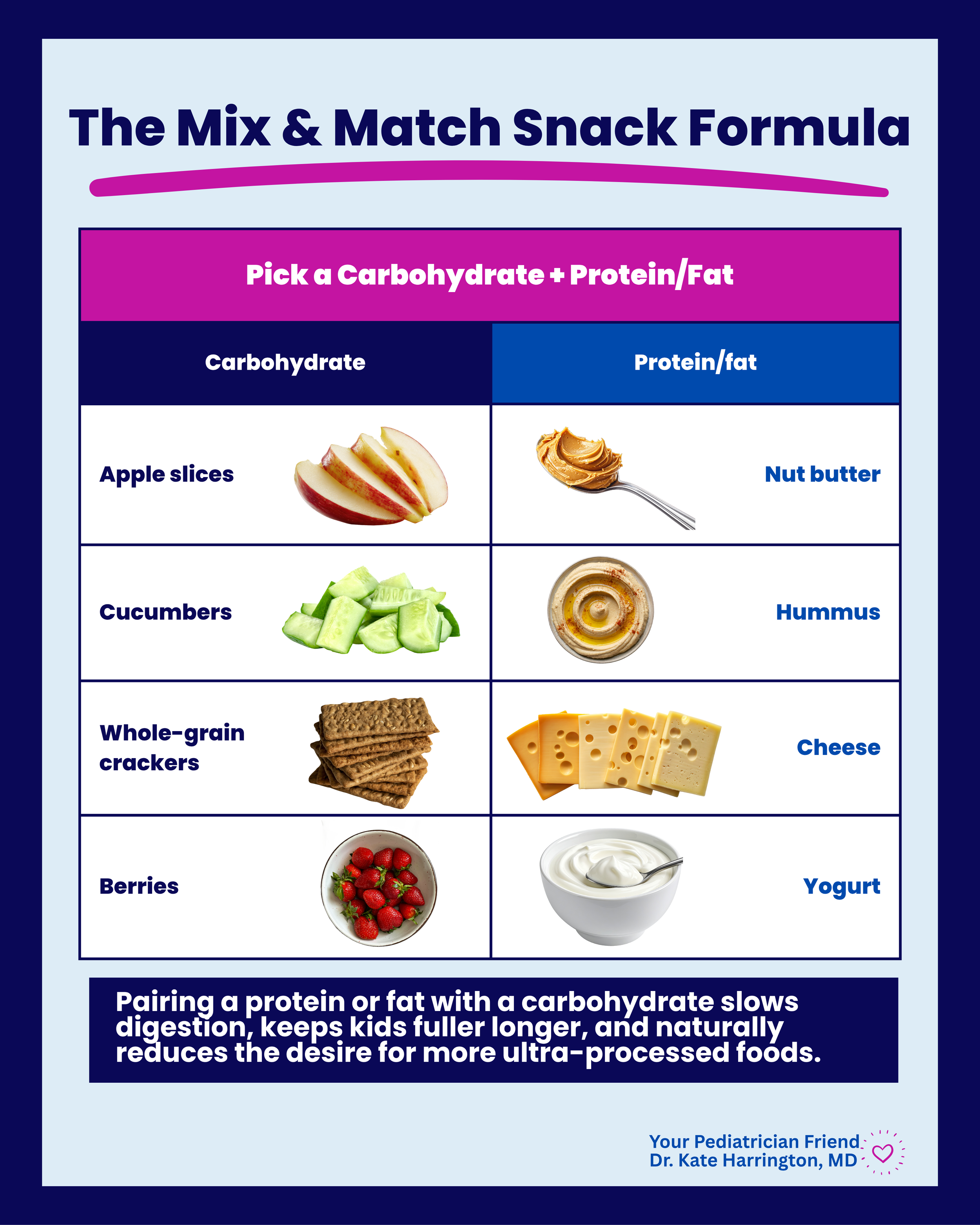
Here's a framework for building snacks that are both satisfying and nutritious: pair any protein or fat with any fruit or vegetable.
Why? Well, most ultra-processed snack foods are high in refined carbohydrates and low in protein and fiber, which means they digest quickly, don't provide lasting fullness, and lead to more grazing throughout the day. Pairing a protein or fat with a carbohydrate slows digestion, keeps kids fuller longer, and naturally reduces the desire for more ultra-processed foods.
Some easy examples:
Fruit + nut butter
Yogurt + granola or fruit
Cheese + whole grain crackers
Hummus + vegetables
None of these require cooking, and most can be assembled in minutes. And they work for after school, car snacks, and activity bag snacks…just as well as anything in a crinkly package!
Picky Eaters (And Why No One Should Be the Food Police)
Who out there has a picky eater? I would guess most of you!
I think it is important that families know that food preferences are to be allowed and respected. Trying new foods should be celebrated, but never coerced. And there are no bad foods.
That last one surprises people sometimes. But the research on picky eating and food restriction is pretty clear: pressure, shame, and restriction tend to backfire. They increase anxiety around food, encourage preferences for the "forbidden" foods, and make mealtimes miserable for everyone. The 8-year-old who will only eat chicken nuggets isn't going to be helped by a parent standing over her demanding she try broccoli. She's going to be helped by calm, repeated, no-pressure exposure to a variety of foods over time.
What actually works, according to the evidence:
Eating together as a family: family meals are consistently associated with a higher quality diet in children, probably because kids model what they see adults eating
Cooking together: kids who help prepare food are more willing to taste it. Research shows that involving children in cooking increases their willingness to try new foods and reduces fear of new foods (or food neophobia—that’s a fun term! Maybe you’d prefer to call your picky eater a food neophobe instead)
Growing things: even a small pot of herbs or a tomato plant on the porch increases kids' interest in whole foods
Embracing all food groups: not treating any food as forbidden or "bad"
And remember, this is a long game!! Expanding a picky eater's palate takes months or years, not weeks. The short-term goal is to make mealtimes less stressful and gradually improve the overall pattern—not to achieve dietary perfection by next Thursday when you have your child’s well check scheduled.
🩺Pediatrician's Insight:I've had the "my kid only eats beige foods" conversation hundreds of times throughout my career. The answer is never "make them eat it"—that approach is well-studied and it reliably backfires. What I tell parents instead: you control what's offered and when it’s offered, and your child controls whether they eat it and how much they eat. (This is the "Division of Responsibility" framework developed by Ellyn Satter, and it's the gold standard in pediatric feeding.) Your job is to put reasonably healthy options in front of them, repeatedly, without pressure or drama. Their job is to eventually decide to try them—on their own timeline, not yours.
Active Kids and Teens
Here are two more common situations worth addressing briefly.
For athletes: If your child is on a competitive sports team and their coach is recommending they "track macros" to optimize performance, a heads up: for most children and early adolescents, macro tracking is unnecessary, potentially anxiety-provoking, and misses the forest for the trees. The foundation of sports nutrition is exactly what we've been talking about in this post: reducing ultra-processed food reliance, eating regular balanced meals, and fueling with whole foods. Young athletes benefit from good food patterns, not spreadsheets.
🩺 Pediatrician's Insight:The best "performance nutrition" for most kids playing recreational and even competitive sports isn't macro tracking—it's reliable meals, adequate hydration, and enough variety to cover their energy needs. A 12-year-old soccer player who regularly eats drive-thru between school and practice will benefit far more from a whole-food breakfast and a decent lunchbox than from calculating their protein-to-carb ratio. If your child's coach is pushing macro tracking for a child under 16, that's worth a conversation with your pediatrician—particularly given the well-established links between early nutrition restriction and disordered eating.
For teens: Adolescence is when autonomy over food choices really matters. Rigid restriction and shame don't work with teenagers. If anything, they reliably produce the opposite of what you want (hello, regular runs to the gas station for Flamin’ Hot Cheetos and Takis!). The approach that works is collaborative: acknowledge their preferences, explain the why without lecturing, and problem-solve together. The 17-year-old who eats pizza rolls at midnight because they’re not hungry until late isn't going to respond to "just stop eating those." They’re going to respond to finding a late-night snack option that they actually like and is a bit less processed.
Meet kids where they are. That's always the right starting point.
The Bottom Line
Ultra-processed foods make up a huge portion of what American kids eat, and the research is building a clear case that this matters for their long-term health. But the goal is not perfection, it's not zero ultra-processed foods, and it's definitely not making every meal a battleground.
The highest-impact places to focus your energy are the everyday routines: breakfast quality, lunchbox swaps, snack upgrades, simple home-cooked meals, and learning to read a food label. Small, consistent improvements in those areas will do far more for your child's health than occasional heroic efforts at perfect eating.
So, no guilt, no shame, no food police! You're already doing better than you think—and I'm here if you want to talk through what changes might actually work for your family 💕

Sources:
American Academy of Pediatrics. Webinar: Ultra-processed Foods and Pediatric Nutrition Counseling: Key Messages for Clinicians and Families. April 21, 2026.
Williams AM, Couch CA, Emmerich SE, Ogburn DF. Ultra-processed food consumption among youth and adults: United States, August 2021–August 2023. NCHS Data Brief. 2025 Aug;(536)1–11. DOI: https://dx.doi.org/10.15620/cdc/174612
Juul F, Martinez-Steele E, Parekh N, Monteiro CA. The role of ultra-processed food in obesity. Nat Rev Endocrinol. 2025 Nov;21(11):672-685. doi: 10.1038/s41574-025-01143-7. Epub 2025 Jul 14. PMID: 40659796.
Powell LM, Leider J, Schermbeck RM, Vandenbroeck A, Harris JL. Trends in Children's Exposure to Food and Beverage Advertising on Television. JAMA Netw Open. 2024 Aug 1;7(8):e2429671. doi: 10.1001/jamanetworkopen.2024.29671. PMID: 39172450; PMCID: PMC11342137.
Zhao S, Li Q, Chai Y, Zheng Y. Nutritional Content of Ready-to-Eat Breakfast Cereals Marketed to Children. JAMA Netw Open. 2025 May 1;8(5):e2511699. doi: 10.1001/jamanetworkopen.2025.11699. PMID: 40397447; PMCID: PMC12096261.
Song S, Tabares E, Ishdorj A, Crews M, Dave J. The Quality of Lunches Brought from Home to School: A Systematic Review and Meta-Analysis. Adv Nutr. 2024 Aug;15(8):100255. doi: 10.1016/j.advnut.2024.100255. Epub 2024 Jun 12. PMID: 38876395; PMCID: PMC11324822.
Maiz E, Urkia-Susin I, Urdaneta E, Allirot X. Child Involvement in Choosing a Recipe, Purchasing Ingredients, and Cooking at School Increases Willingness to Try New Foods and Reduces Food Neophobia. J Nutr Educ Behav. 2021 Apr;53(4):279-289. doi: 10.1016/j.jneb.2020.12.015. Epub 2021 Feb 9. PMID: 33573994.