My Kid Got Too Much Sun. Now What?
A pediatrician's guide to preventing sunburn, treating it when it happens, and knowing when to actually worry.

Summer is here—thank goodness! It is such a magical time for kids. Our sunny days are longer, kids are getting more outdoor time, and maybe a bit more freedom than the school year allows. But summer also brings more questions about sun protection, sunscreen, and sunburn.
And rightly so. Sunburn is painful and no fun—but repeated sunburns can lead to lasting skin changes (like wrinkles and sun spots), eye issues like cataracts, and even skin cancer. So let's talk about the sun, your kid's skin, and what I actually think about when one of my own kids comes home pink.
Because it happens to all of us.
First: How Does Sunburn Actually Happen?
The sun emits two types of ultraviolet (UV) light that matter for skin:
UVA rays penetrate into the deeper layers of skin. They're the ones responsible for long-term skin damage and cancer risk. And they're sneaky because you don't feel them happening.
UVB rays penetrate more superficially and cause the sunburn you can see and feel.
When UV rays damage the skin, your immune system responds with inflammation. That's what the redness and heat actually are—your body mounting a defense.
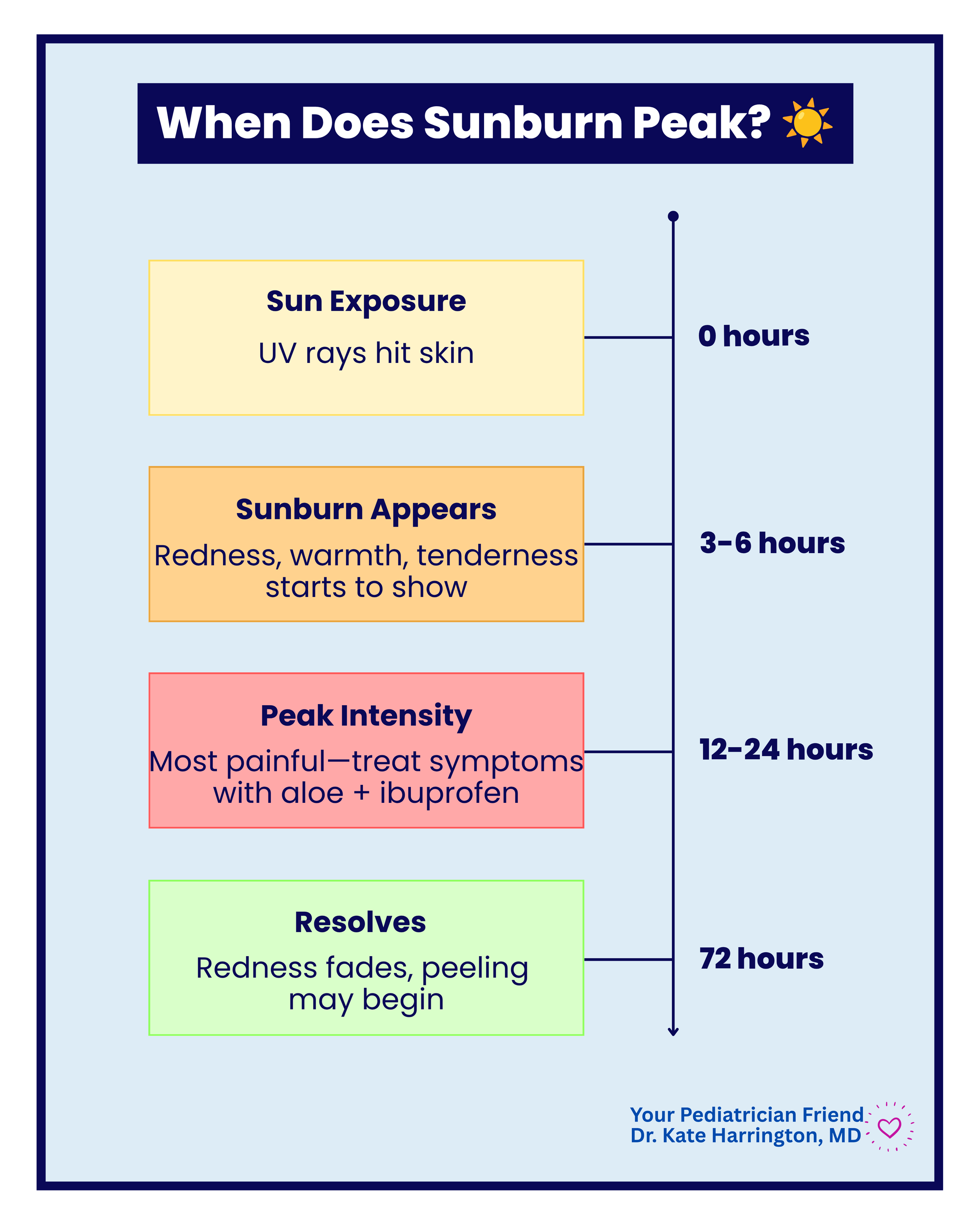
Sunburn usually shows up 3–6 hours after sun exposure, peaks at 12–24 hours, and typically starts to resolve by 72 hours. So if your kid looks fine when you leave the pool but looks like a lobster at bedtime? That's completely normal timing.
Sunburn levels: how bad is my child's sunburn?
Parents often ask about "sunburn levels," but there isn't one official sunburn grading system. Medically, I think about sunburn in two ways:
How deep is the burn? Is this a first-degree sunburn, where the skin is red and painful but not blistered? Or is it a second-degree sunburn, where the skin has blistered?
How is the child acting overall? A child with a bad sunburn who is drinking, peeing, and acting normally is very different from a child who is vomiting, dizzy, feverish, or confused.
Here's the practical way I'd sort it out:
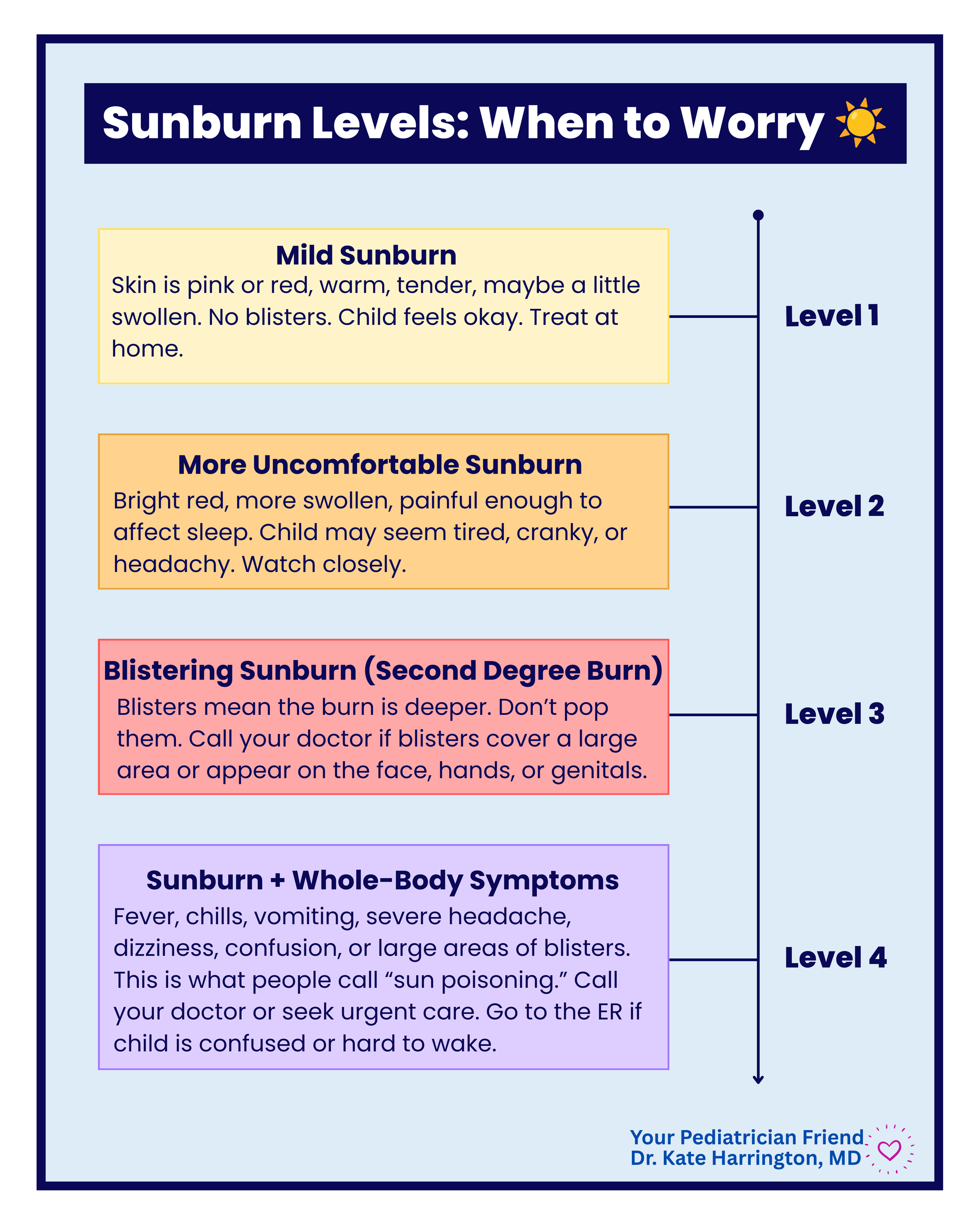
Level 1: Mild sunburn
This is the classic "oops, we missed a spot" sunburn. The skin may be pink or red, warm to the touch, tender or itchy, a little swollen, or painful when clothing rubs against it. No blisters are present, and your child otherwise feels okay. Most mild sunburns can be treated at home with cool compresses, aloe or moisturizer, fluids, and pain medicine if needed.
Level 2: More uncomfortable sunburn
This level is more than just a little pink. The skin may be bright red, more swollen, painful enough to interfere with sleep, or very sensitive to touch. Your child may also seem tired, cranky, headachy, or a little off. This can still often be managed at home if your child is drinking well, peeing normally, and acting like themselves. But it deserves closer watching, especially if a large area of skin is involved.
Level 3: Blistering sunburn
Blisters mean the sunburn is deeper—this is considered a second-degree sunburn. They may be small or large, and sometimes don't appear until hours later or the next day. Resist the temptation to pop them—blisters act as a natural bandage, protecting the healing skin underneath. Call your child's doctor if blisters cover a large area, appear on the face, hands, or genitals, or your child also has fever, chills, headache, or vomiting.
Level 4: Sunburn plus whole-body symptoms
This is the most worrisome level and what people often call "sun poisoning" (although that is not an official medical term). The skin may look burned, but the bigger issue is how your child is acting. Call your child's doctor or seek urgent care if your child has fever or chills, vomiting, severe headache, dizziness or fainting, signs of dehydration, severe pain, large areas of blistering, eye pain or sensitivity to light, or spreading redness, pus, or red streaks.
Go to the ER if your child is confused, difficult to wake, having a seizure, very weak, or not acting like themselves after heat exposure.
🩺 Pediatrician's Insight: The redness is what parents notice first, but your child's behavior is what I care about most. A bright red kid who is eating a popsicle and complaining loudly about their sunburn is usually less concerning than a less-red child who is confused, limp, vomiting repeatedly, or just not acting right.
What To Do When Your Child Gets Burned
Despite everyone's best efforts, sunburns happen.
Here's what to do:
Cool it down. A cool (not ice cold) compress or a lukewarm bath can bring significant relief. Avoid anything that keeps heat in—no tight clothing or heavy moisturizers (like Aquaphor or Vaseline) right away.
Moisturize gently. Once the skin has cooled, apply aloe vera gel or a gentle fragrance-free moisturizer. Aloe is usually soothing for mild to moderate burns.
Manage the pain. If your child is uncomfortable, ibuprofen or acetaminophen (given at the appropriate dose for their weight) can help with both pain and inflammation. Ibuprofen is especially good here since it targets inflammation.
Manage the itchiness. If your child is itchy after sunburn, calamine lotion can be helpful.
Keep blisters intact. If small blisters form, leave them alone—they're protecting healing skin underneath. Popping them increases the risk of infection.
Stay hydrated and out of the sun. Burned skin is compromised skin. Until it heals, it's more vulnerable to further damage. And sunburned kids often need extra fluids.
When to Call the Doctor or Head to Urgent Care
Seek extra help if your child has:
Blistering over a large area of the body
Fever—especially with a sunburn, this can indicate heat stroke or sun poisoning
Signs of dehydration—very dry mouth, no tears, not urinating at least once every 8 hours
Dizziness, confusion, or unusual behavior
An infant or very young child who got significant sun exposure (babies have much less reserve)
Burns that look infected: increasing redness, warmth, pus, or red streaking after the first few days
If your child seems very sick, not just sunburned, trust that instinct and get some extra help.
Prevention: Your Lines of Defense
Now let's talk about what to do before the burn. You have several solid tools.
Cover Up
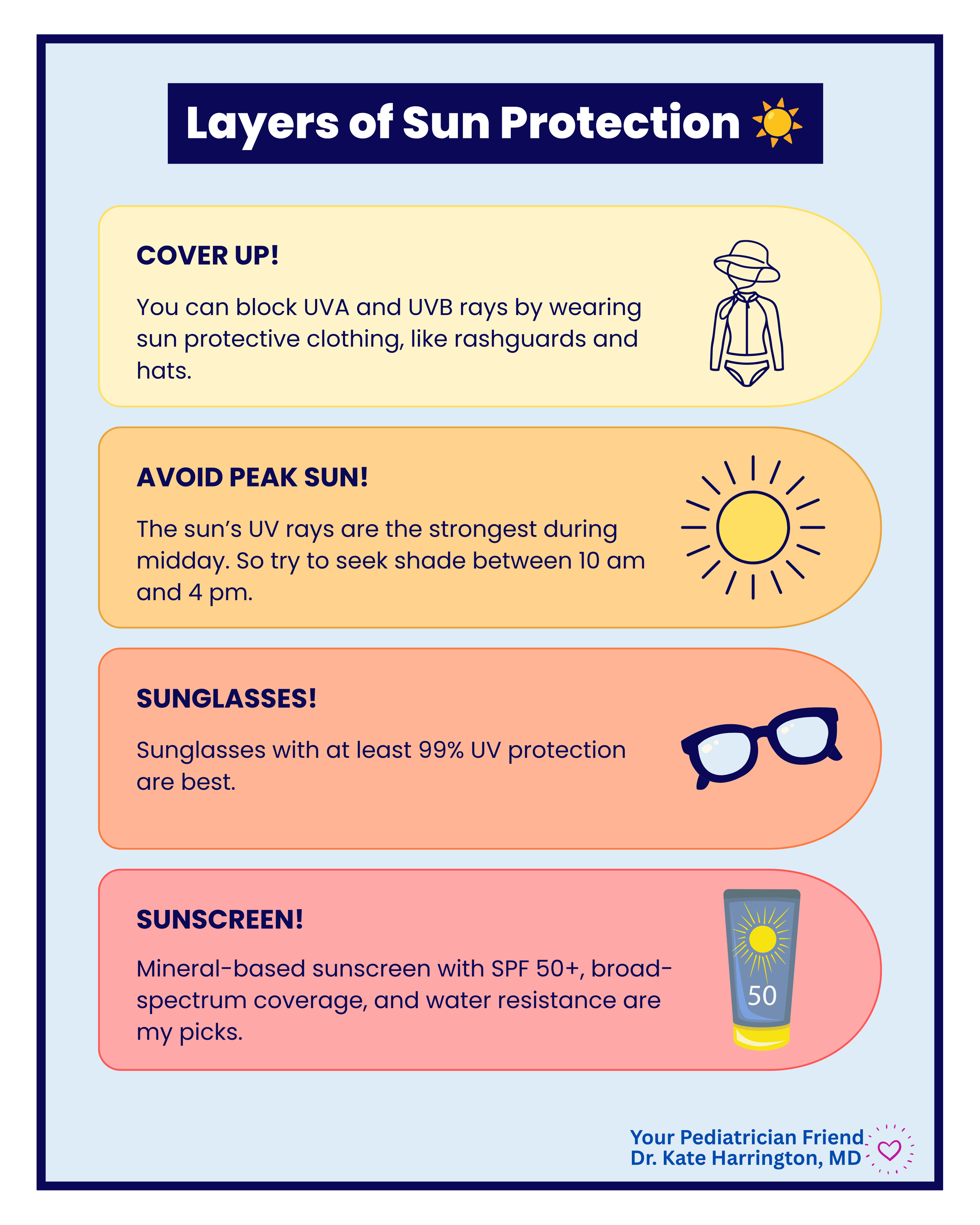
Sun-protective clothing and hats are your first line of defense—especially for babies and toddlers where applying and reapplying sunscreen is genuinely difficult!
A good sun hat with a wide floppy brim covers the face, ears, and back of the neck. I'm partial to hats with a strap (adjustable, ideally breakaway for safety) because they actually stay on. As kids get older and start having opinions, a well-fitting ball cap is better than no hat—just remember to put sunscreen on the ears!
For swim days, a rash guard or swim shirt is a game-changer. Water and sand both reflect UV rays, which slightly increases exposure. And water rinses off sunscreen faster. Look for UPF 50+ on the label (that's the clothing equivalent of SPF).
For sunglasses, look for at least 99% UV protection. Let your kid pick them out. The ones they think are cool are the ones they'll actually wear.
Timing Matters
The sun's UV rays are strongest between 10 AM and 4 PM. That doesn't mean you can't be outside. However, seek shade more often during those hours. And remember, cloudy days count since UV rays can penetrate cloud cover. Overcast summer days catch people off guard every year.
💡 Fun Fact: Most weather apps include something called the UV index—a daily forecast of sunburn risk based on local conditions. The scale runs from 0 to 11+, with 0 meaning no risk and 11+ meaning extreme risk. It's worth getting in the habit of checking it the same way you check the temperature—especially on summer days when you're planning to be outside for a while.
Sunscreen: What Actually Matters
There are approximately nine thousand sunscreen options and I understand why standing in the sunscreen aisle at Target feels so overwhelming!
Here's what I actually look for:
SPF of at least 30. I personally prefer 50.
Broad spectrum. This means it protects against both UVA and UVB.
Water resistant. If your kid is swimming or sweating, this matters (and aim for sunscreens that are 80 minutes resistant).
For kids, I recommend mineral-based sunscreens containing zinc oxide or titanium dioxide. Children's skin is more permeable than adult skin, and mineral formulas sit on top of the skin rather than being absorbed. I also avoid sunscreens with oxybenzone (potential hormone disruptor) and PABA (can cause skin irritation).
Quick News: The FDA Just Approved a New Sunscreen Ingredient
In June 2026, the FDA approved bemotrizinol for use in sunscreens sold in the US (you may see it listed as "BEMT" or under the brand name Parsol Shield). It’s the first new sunscreen active ingredient approved in the US in about 20 years, even though it's been used safely in Europe and Asia for decades.
What makes it different:
It's an organic (carbon-based) filter that provides strong, stable UVA and UVB protection
It absorbs and dissipates UV rays without being significantly absorbed into the bloodstream. This makes it advantageous over other chemical sunscreens.
It's been shown to cause very low skin irritation, and therefore has been cleared for children as young as 6 months.
As for form: I prefer cream over spray. With a cream, you can see where you've covered. Sprays can miss spots and raise concerns about inhaling the product. A stick is great for quick face touch-ups on the go, but I find it harder to get complete coverage across a larger area.
🩺 Pediatrician's Insight: The amount matters as much as the SPF number. The recommendation for an adult covering their whole body is about one full ounce (roughly a shot glass worth). Most people apply far less than that, which means their "SPF 50" is functionally much lower in practice. For kids, scale appropriately, but don't be stingy!
Reapply every 2 hours. If you are swimming, reapply immediately after exiting the water (regardless of when you last applied).
My Favorite Sunscreen Brands
After years of trialing these on my own kids (and recommending them to countless families), here's what I like:
ThinkBaby/ThinkKids/ThinkSport—Gentle, easier to spread than many mineral options, water resistant up to 80 minutes, reef safe.
Cetaphil Sheer Mineral SPF 50—Great for sensitive skin, rubs in relatively easily, fragrance-free, water resistant up to 80 minutes, reef safe.
CeraVe Hydrating Mineral SPF 50—Also excellent for sensitive skin, fragrance-free, reef safe. Note: not water resistant, so not the pick for swim days.
For face (especially if your teen wears makeup): Elta MD's mineral tinted line goes on without a white cast and is excellent. It's pricier, but worth it if the white sheen of other mineral formulas is a barrier.
If your child wears makeup, sunscreen goes on before foundation, not after.
🩺 Pediatrician's Insight: Any sunscreen your child will actually wear is better than no sunscreen. So if your child absolutely refuses mineral-based lotion but tolerates a sunscreen spray, use the spray. Just spray it into your hand first when applying to the face, rub it in so you don’t miss spots, and avoid having your child inhale the mist.
What About Babies Under 6 Months?
If you’ve read the fine print on sunscreens, you’ve probably read that they are not recommended for babies under 6 months. This is because the official guidance is to keep infants under 6 months out of direct sunlight—their skin is more sensitive and they have limited ability to regulate body temperature through sweating. However, this isn't always possible! I recommend dressing babies in lightweight protective clothing, keep them as shaded as possible, and if it’s impossible to avoid the sun use a mineral-based sunscreen on exposed areas. Plan to give them a bath when you're done outside.
Skin Tone and Sun Protection
Every skin type can get sunburned and should be protected from the sun.
Melanin, the pigment that gives skin its color, does provide some natural UV protection. But it's not a shield. A tan, which many people associate with looking "healthy," is actually a sign of skin damage. It's your skin's response to UV injury. It doesn't protect your child from the negative effects of the sun.
Skin cancer affects people of all skin tones. And importantly, people with darker skin are often diagnosed later because they (and their doctors) may be less suspicious. Unfortunately, this can make outcomes worse. No child's skin is exempt from needing protection.
The Bottom Line
Sun protection is about building habits that protect your child's skin for their whole life. Blistering sunburns in childhood are meaningfully associated with increased skin cancer risk down the road, and most of that risk is preventable.
But if your kid gets burned despite your best efforts? Please don't spiral! Treat the symptoms, watch for the warning signs above, and move on. I've been there. We all have.
Have a wonderful, sun-filled summer. ☀️

Planning summer travel with your kids?
My Traveling with Kids: A Pediatrician's Guide to Staying Healthy on Vacation was made for exactly this time of year. It includes a sunburn guide, a travel health packing list, illness guides for the most common vacation health issues (swimmer's ear, motion sickness, traveler's diarrhea, altitude sickness, and more), and medication guides for 11 common travel medications—so you know exactly what to bring and what to do if something comes up far from home.