Raising a Resilient Teen Starts With These 5 Things
The research-backed framework every parent of a teen should know
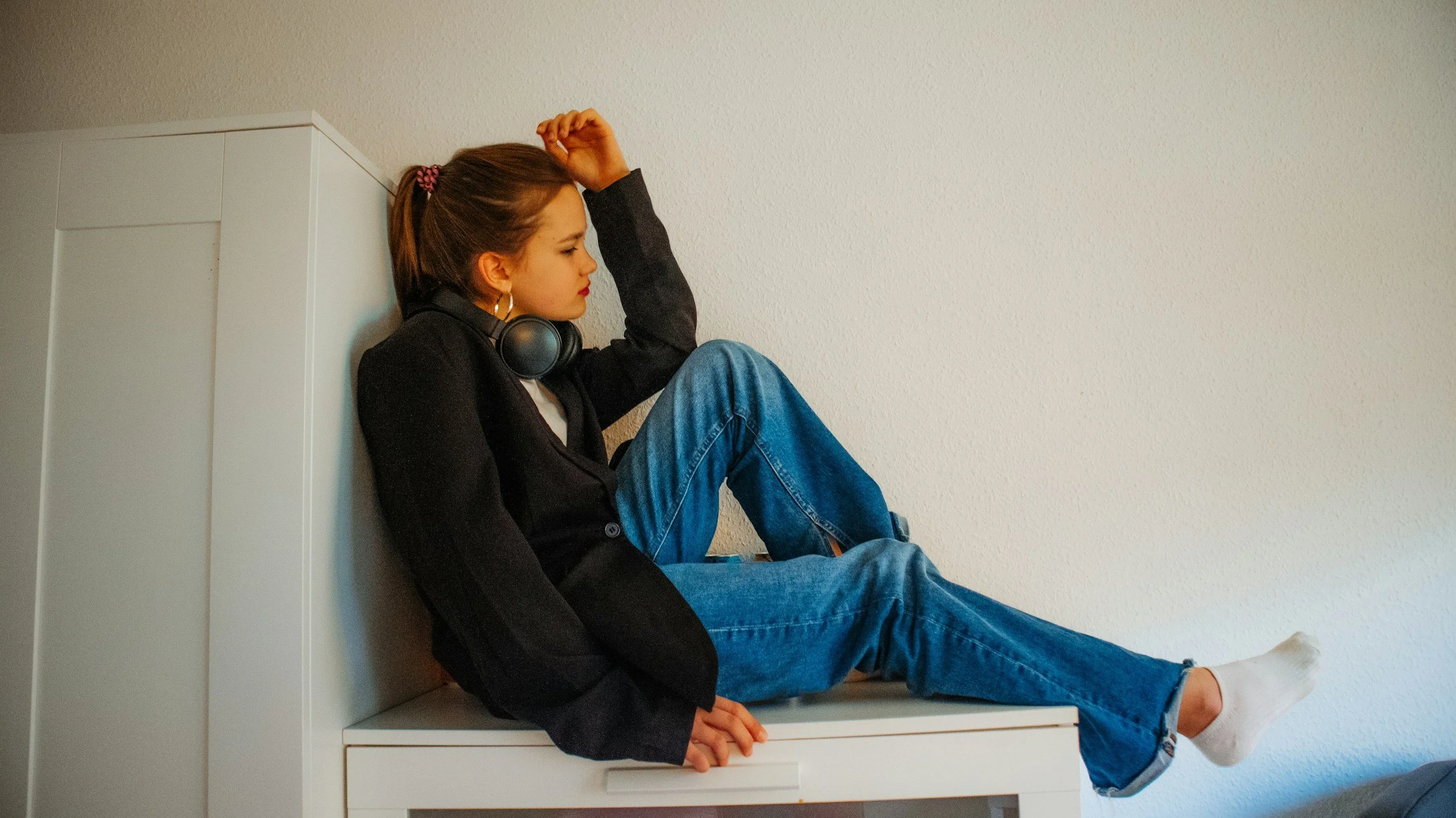
If you've ever stood outside your teenager's closed bedroom door, hand raised to knock, trying to figure out what to even say…same.
Parenting a teen through stressful times is one of those things no one really feels prepared for. The toddler years involved regular doctor visits, ECFE classes, and so many books. But the teen years? It just feels a lot more complicated. There is conflicting advice on the internet, a lot of moments where you're really not sure if you're helping or making it worse, a sophisticated teenager who has perfected the skill of arguing, and no play dates to talk it all through with your mom friends.
But thankfully the American Academy of Pediatrics has put together a simple framework called the 5Rs—five things parents can do consistently to support their teen's resilience. This is especially helpful right now—the end of the school year where your teen’s schedule is bursting at the seams. And the great thing is that it feels doable. It doesn't require you to say the perfect thing (phew!). It just requires you to show up in a few specific ways. And chances are, you're already doing some of them!
Let's walk through each one.
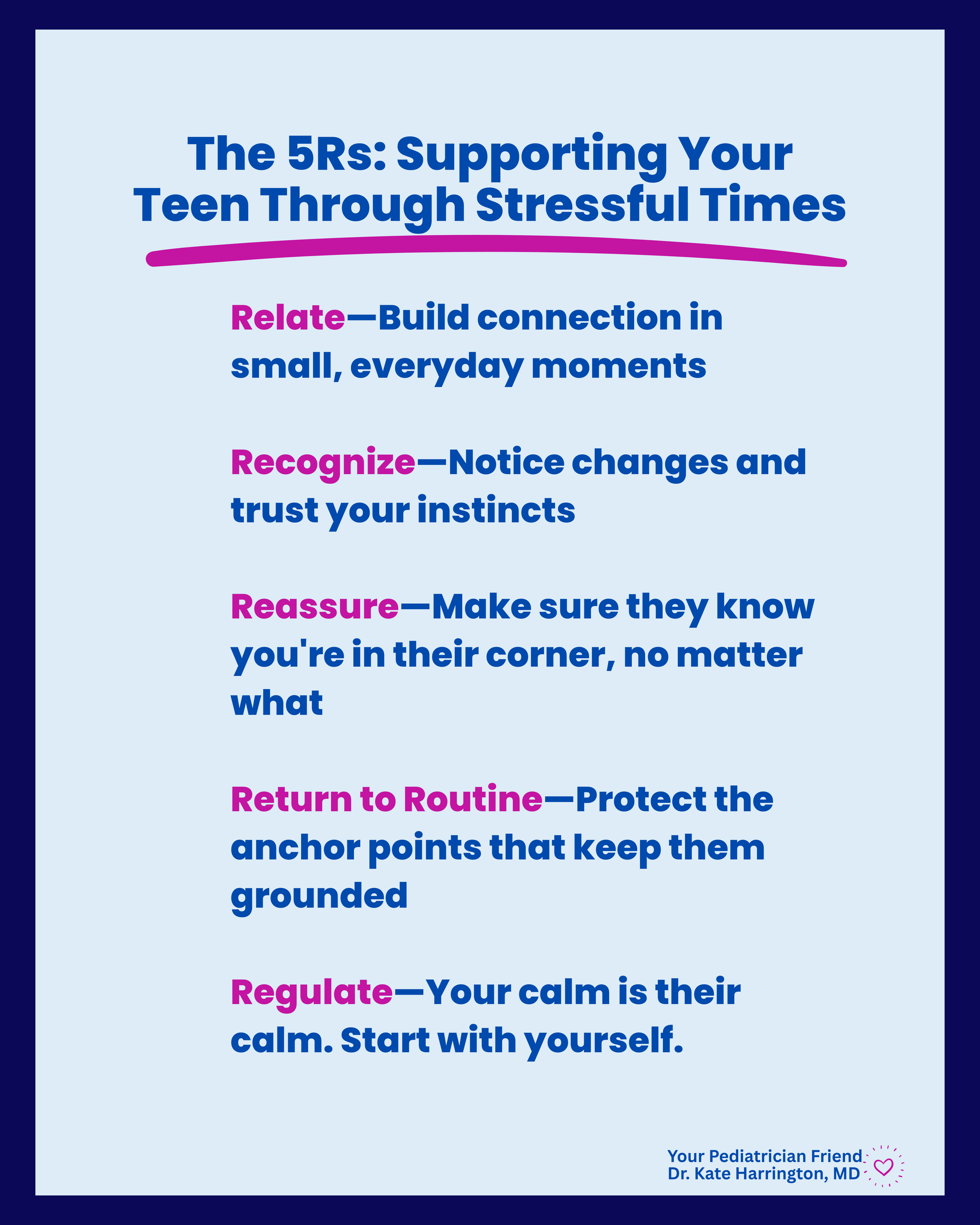
1. Relate: Build connection in the small, everyday moments
Even as teens pull away (and they will pull away—that's developmentally right on schedule) they still need their families more than they let on. Connection is the foundation—which is exactly why it comes first.
And it’s easier than it seems. You don’t need to have multiple heart-to-heart talks throughout the week. Instead, the key is to find low-pressure moments to connect: car rides, family meals, a shared walk, watching something together on the couch. During these times you don’t need to have an agenda or tick off a list of teachable moments—just put in time together. And remember that those side-by-side moments like car rides and walks are usually more effective because your teenager doesn’t feel like they are being studied. Their brains are so sensitive to feeling evaluated—the last thing they want is to feel like your heart-to-hearts are an interrogation.
And I know what you are thinking. What if they're not into it? Well, first of all, don't take it personally! When teens are struggling, they often pull away hardest when they need it most. So eye rolls and slammed doors are expected. And second, don't stop trying. Keep making small, low-stakes gestures with zero expectations of a response. Leave their favorite snack outside their door. Send a meme you think they'd like. Offer to take them on a Starbucks run, and accept no for an answer without making it a thing. Your goal is to keep making deposits into an account that feels empty. And eventually, when they're ready, they will make a withdrawal! So keep that account open and maintain that minimal balance. (And keep making ridiculous metaphors…they secretly love that!)
Try saying:
"Would you want to hang out for a bit?"
“I know it's hard. I've felt that way too sometimes—you're not alone in this."
“I really admire the effort you put in. That took guts."
2. Recognize: Notice changes—and trust your instincts
You know that feeling when something seems off with your kid, but you can't quite figure out what it is? Trust that feeling! You know your teenager better than any parenting account on social media, any Google search, and honestly—better than me!
Watch for small shifts: they're quieter than usual, sleeping more, losing interest in things they loved, or spending a lot more time on their phone. If you notice something, you don't need to diagnose it or fix it immediately. Try to just gently name it, without judgment, and allow space for connection. And often the most powerful thing you can do is simply listen. Don’t jump in with advice or try to fix the problem. Just sit with them and listen.
But when should you be worried? How do you know what's normal teenage moodiness and what's not? The distinction is that normal teen stress tends to be situational and temporary—it tracks with something specific (a test, a fight with a friend, a break-up) and eases when the situation resolves. It might be very intense and dramatic, but it eventually moves on.
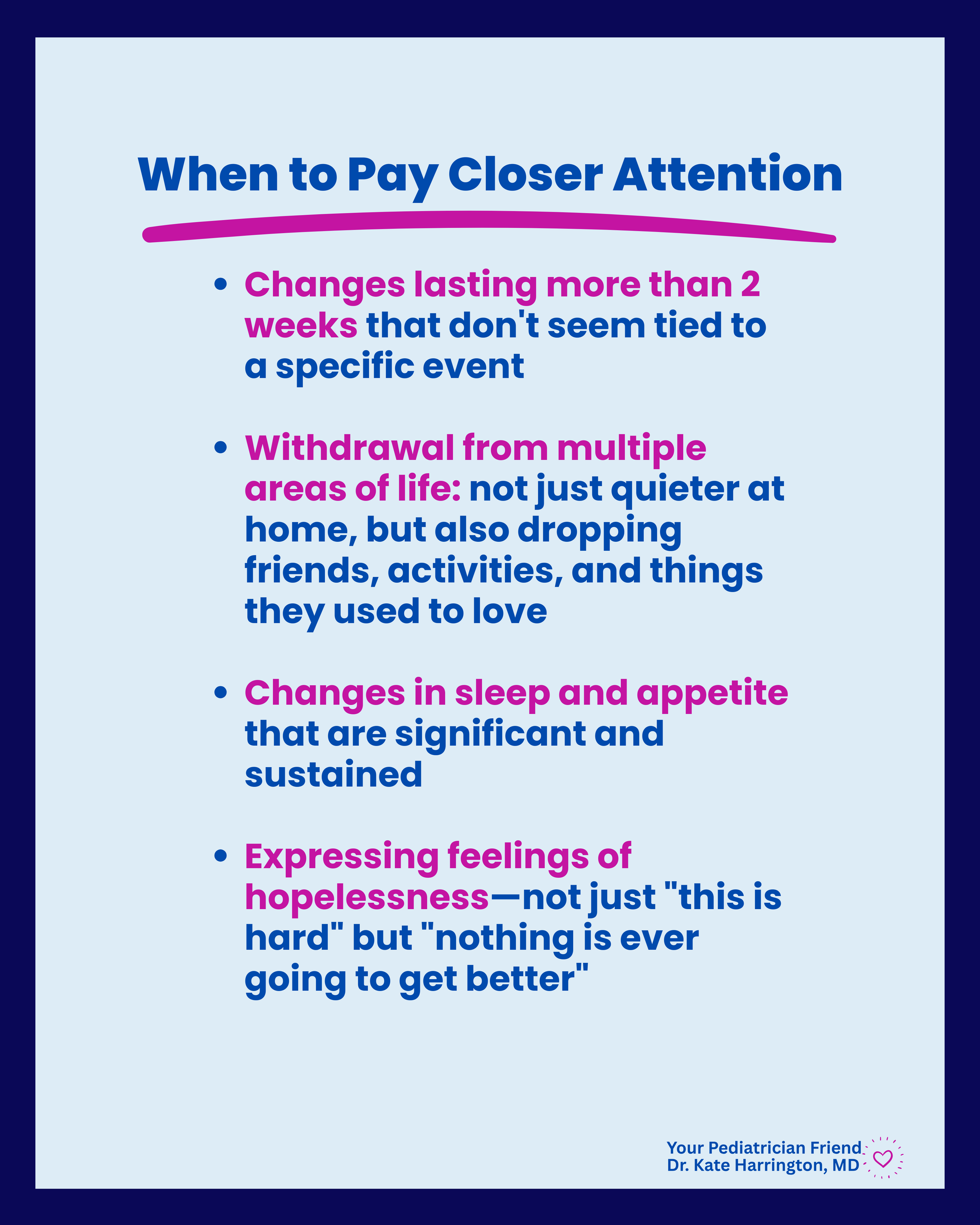
When changes are persistent, affect everything, and truly represent a departure from your teen's baseline, that warrants more attention. Specifically watch for:
Changes lasting more than 2 weeks that don't seem tied to a specific event
Withdrawal from multiple areas of life: not just quieter at home, but also dropping friends, activities, and things they used to love
Changes in sleep and appetite that are significant and sustained
Expressing feelings of hopelessness—not just "this is hard" but "nothing is ever going to get better"
And like so many thing in parenting, trust your gut! If something feels different, off in a way you can't quite describe, that’s important. Bring it up with a pediatrician—we would always rather you call and have it be nothing than not call and wish you had.
Try saying:
“I've noticed you've seemed a little off lately. You don’t have to tell me anything you don’t want to—I'm just here if you want to talk."
“You don't have to have it all figured out. I just wanted you to know I see you."
3. Reassure: Help your teen feel safe, supported, and understood
Teens need to know they can count on you. Even when things get messy. Even when emotions are running high. Even when they've said something unkind. Even when they've made a mistake (even a huge mistake). Your calm, steady presence is more reassuring than you realize.
You can build that trusting and supportive relationship a few simple ways. When talking to your teen, reflect back what they share to show you're actually listening. When they are facing a tough situation, remind them of the times they've gotten through hard things before—this builds their belief in their own ability to cope. And remind them, over and over, that they are not alone. That they always have people in their corner (most importantly, you!) who are available when something feels overwhelming or impossible.
Also understand that it’s normal as a parent to dwell on previous conversations with your teens, especially when they haven’t gone well. And it’s also normal to wonder, What if I've already gotten it wrong? What if I reacted badly, or said something dismissive, or lost my temper…and now my teen doesn't trust me the way they used to?
First: you have not permanently damaged your relationship. I promise. Repair is not only possible, it's actually one of the most powerful things you can model. A parent who can say "I handled that badly and I'm sorry" is teaching their teen something more valuable than a parent who never makes mistakes. They're showing them that relationships can survive conflict and hard times. That it is safe to admit you did something wrong, and that your love endures. And that love and support don't require perfection!
So if (or more like when!) you find yourself in a situation that needs repair, here is how you do it: name what happened, own your part, and don't make it about you. Not "I'm sorry if I upset you" (that's not really an apology) and not a five-minute explanation of why you reacted the way you did (that's making the conversation about you). Just: “I said something harsh the other night and I've been thinking about it. That wasn't fair to you. I'm sorry." Then stop talking. Let them respond…or not. Your goal is to keep the door open for further conversation and connection.
Over time, consistent reassurance (especially the unconditional kind) helps build a solid foundation where your child feels safe and supported. In a world where teenagers are constantly being evaluated by grades, peers, social media, coaches, and college applications, knowing that one person is completely in their corner, no matter what, is extremely powerful.
Try saying:
"Whatever it is, I'm here no matter what. We'll get through it together."
“You don't have to talk right now. I'm here whenever you're ready."
“That sounds really hard. I'm really glad you told me."
“You've gotten through tough times before. What do you think might help this time?"
💡 Fun Fact: Research has found that teens with higher resilience don't experience less stress than their peers. Instead, their emotions are just more stable when stress hits. What sets them apart is how they cope: talking things through with trusted people and reframing situations in a more helpful light. You can actively support both of these things as a parent!
4. Return to Routine: Support the rhythms that keep your teen grounded
Predictable routines help teens feel safe and grounded, especially when the rest of their world feels chaotic. And during high-stress stretches like finals, routines are usually the first thing to go—late nights, skipped meals, dropped activities, and suddenly your teen hasn’t left their room or touched grass in four days.
So try to preserve at least a few of their routines. Work together to pick one or two things to protect: a family meal a few nights a week, a consistent bedtime on school nights, a daily walk. If you acknowledge that they are stressed and that it feels hard to do it all, but work collaboratively on which routines should stay in place, they are more likely to adhere to the plan.
Of all the routines, sleep is probably one of the most important ones to maintain. When a teenager is sleep deprived, their brain’s emotional alarm system (the amygdala) becomes much more reactive. At the same time, the prefrontal cortex, which is responsible for regulating emotional responses, is less able to do its job. The result is a brain that is primed to perceive threat, but isn’t able to regulate its response. No wonder your teen feels like every stressor is WAY bigger than it is, is maybe making poor decisions, and gets mad at the drop of a hat. Their overtired brain can’t function in any other way.
Try saying:
“Let's look at the week together and figure out what's actually doable."
“I really like our [dinner / drive / whatever your thing is]. Even though it’s a busy week, let's keep that going."
"You've worked really hard this semester. Sleep is actually one of the best things you can do for your brain before finals."
🩺 Pediatrician's Insight: Teenagers need 8–10 hours per night. Most are getting much less, and during finals, even less. I know enforcing this with older teens can feel virtually impossible. So, focus on what you can control. And one thing you can control is if your teen has a phone in their bedroom. The research on phone use and sleep is very clear—the blue light, the social comparison, the notification anxiety all interfere with sleep in ways that have absolutely nothing to do with willpower. A phone charger in the hallway is not a punishment! It’s just a reasonable parenting intervention.
5. Regulate: Support your teen's emotional growth—starting with yourself!
Teens can only regulate their own emotions when the adults around them are regulated. Which means the most important thing you can do in a tense moment is not have the perfect response ready. It's to be calm. So don’t panic that you don’t know what to do—just take a breath and a beat.
Check in with yourself first. Are you calm? Think about some of the signs of dysregulation that can be hard for us to recognize: a tight chest, slightly clipped responses, a strong feeling that you need to solve this right now. If you find yourself frustrated, anxious, reactive, and not calm, your teen (and their nervous system) is probably picking up on it too. So it is completely okay to pause. Take one slow breath out (and you read that right—not in, but out). A long exhale activates our parasympathetic nervous system and begins to bring your heart rate down within seconds. Then try to drop your shoulders and soften your face. If you still don’t feel ready, say so: “I want to talk about this and I want to do it well. Can we come back to this in ten minutes?” Some parents worry that's avoidance. But it’s not! You are modeling exactly what you want them to learn.
When you (and your nervous system!) are calm and ready, listen for what they actually need from you right now: space, comfort, someone to sit quietly nearby, or just to feel heard. Acknowledge their feelings without judgment. And resist the urge to jump into fix-it mode! Your first step is to just calmly listen.
Try saying:
"When I'm stressed, it helps me to take a walk or talk to someone I trust. What helps you?"
“I'm here if you need a quiet moment. Just let me know what would help right now."
"I'd like to understand what's going on. I'm here to listen—no advice, just listening."
“Is this a time where you want me to offer advice, or just be a listener?”
💡Fun Fact: The science of co-regulation shows that a calm adult nervous system can actually help settle a dysregulated child's nervous system in real time. Your calm is catchy! The research on this is strongest in younger children, but it's increasingly being applied to adolescents too. In a tense moment with your teen, the most important thing isn't finding the right words. It's getting yourself calm first.
You don't have to say the right thing…really!!
Parenting a teen is hard. Like, really hard. And none of this is as simple as it sounds on paper!
Here's what I want you to take away from all of this: you don't have to say the right thing. You don't have to fix it.
You just have to keep showing up—in the car, at dinner, when they grunt at you instead of answering, when the door is closed, even when it feels awkward, hopeless, or slow. That consistent presence is doing more than you know. It's telling your teen: I see you, I'm not going anywhere, you can handle hard things, and you don't have to do it alone.
That's resilience-building. And you're already doing it without realizing 💕
Sources:
American Academy of Pediatrics. The 5Rs: Ways to Support Your Teen's Resilience During Stressful Times. HealthyChildren.org.
Salamon, M. Co-regulation: Helping children and teens navigate big emotions. Harvard Health Blog. April 3, 2024. https://www.health.harvard.edu/blog/co-regulation-helping-children-and-teens-navigate-big-emotions-202404033030
Yu Z and Liu W. The psychological resilience of teenagers in terms of their everyday emotional balance and the impact of emotion regulation strategies. Front. Psychol. 2025;15:1381239. doi: 10.3389/fpsyg.2024.1381239
Ginsburg KR. Building Resilience in Children and Teens: Giving Kids Roots and Wings, 4th ed. American Academy of Pediatrics, 2023.